 | Diagnosis of Malaria |
How do doctors diagnose malaria?
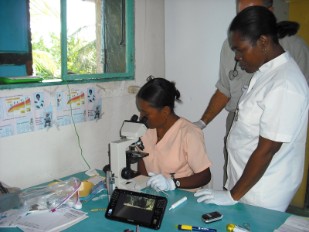
The Centers for Disease Control admits that the diagnosis of malaria is difficult to do correctly. A patient possibly infected with malaria may present with fever, chills, sweats, headaches, muscle pain, nausea, vomiting, high temperature, and tiredness, the same symptoms that can also be caused by influenza or common viral infections (CDC, 2010f). Medical professionals must examine carefully a stained blood smear, which is a sample of the patient's blood on a microscope slide, in order to diagnosis malaria positively and correctly (Blumberg, 2005). Before putting the slide under the microscope the blood will be stained with Giemsa stain to give the parasites a distinctive appearance. They may also find anemia, a decrease in the blood platelets, and higher levels of bilirubin as well as aminotransferases (CDC, 2010f).
But a negative blood smear does not rule out malaria. Rather, if the symptoms are typical of malaria after a doctor finds a negative blood smear, she should order follow up blood smears to be examined from the patient in order to diagnosis or rule out malaria as soon as possible. This will help to prevent possible complications from a delayed diagnosis (Blumberg, 2005).
There are other ways to detect malaria other than just under a microscope. There are test kits available called Rapid Diagnostic Tests that detect antigens that come from the malaria parasites. These RDTs are useful for when microscopes are not available. But improvements still need to be made to RDTs like improving their accuracy and making them more affordable (CDC, 2010f).
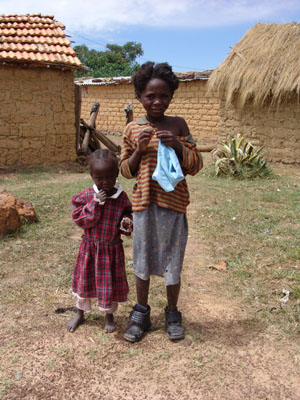 | Who is at risk for contracting malaria? 1. Those in rural areas who cannot afford adequate housing and bed nets. 2. Areas where education about recognizing the signs of malaria is lacking. 3. Travelers from non-endemic areas who do not use insect repellant or preventative malarial medications (including refugees and immigrants from non-endemic areas. 4. Those who live near standing water, in irrigation ditches or pits example. 5. Those who work outside at night, such as harvesters on farms. (CDC, 2010f)
|
How do doctors treat malaria?
Quinine is the choice drug for treating severe malaria. It acts rapidly to combat the disease, and an affordable treatment throughout the world. But in some parts of Africa, such as in western part of the continent, there is evidence of some low-level resistance to quinine developing (Blumberg, 2005). After discovering that quinine is developed from cinchona bark, scientists then created synthetic quinoline-containing medications such as chloroquine, amodiaquine, and mefloquine that have been standard treatment against malaria for decades (Bray, 2005).
Chloroquine has prove to be the cheapest and safest treatment for malaria. But with the emergence of parasite resistance to chloroquine, new drugs are needed to combat the malaria parasite. The development of new drugs takes a lot of money, which poorer countries, the same countries where malaria is endemic, do not typically have (Miller, 1995).
What can people do to prevent contracting malaria?
Antimalarial drugs taken by travelers can delay malaria symptoms by weeks or months, especially with Plasmodium vivax and Plasmodium ovale which produce a parasite that has a dormant liver stage. Since there can be a long period of time between travel and the emergence of symptoms, misdiagnosis of malaria is possible, so travelers and to endemic areas and their doctors should be aware of and treat any flu-like symptoms that present up to a year later as possible cases of malaria (CDC, 2010). Prompt medical diagnosis is important in an effort to prevent severe malaria and other complications. But, malaria can prove challenging to diagnose since its symptoms can mimic the symptoms of influenza, hepatitis, meningitis, septicemia, typhoid, tickbite fever, viral hemorrhagic fever, and HIV seroconversion illness (Blumberg, 2005).
According to the editors of Cecil Essentials of medicine, "malaria prophylaxis is a major problem for international travelers because of the high and increasing prevalence of drug resistance by the parasite" (Bennett, 1995). Travelers can obtain antimalarial drugs from their doctor to take before, during and after traveling to malaria-endemic areas. The CDC also suggests that travelers to endemic area of malaria transmission use insect repellant that contains DEET and/or Picaridin. By using insect repellant, the traveler can reduce their risk of exposure to mosquito bites that may carry the malaria parasite. This will also reduce their risk of other mosquito-borne diseases such as West Nile virus. The repellant should be used whenever the traveler is outside, and especially during the hours between sunset and sunrise. Travelers should use the insect repellant in addition to their antimalarial drugs.
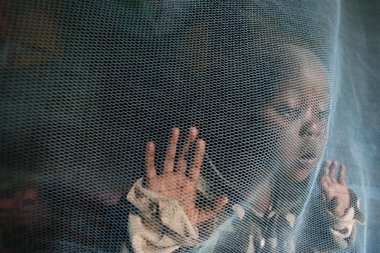
Bed nets treated with mosquito repellant are some of the best preventatives against mosquitoes, and thus malaria.
Are some people immune to malaria?
1. People who are heterozygous for the sickle cell trait, meaning that they carry the trait, are relatively protected against Plasmodium falciparum, the prevalent malaria parasite in Africa. It is also thought that other blood disorders such as blood cell dyscrasias, thalassemias, and G6PD deficiency also provide protection from contracting malaria (CDC, 2010f).
2. People who are negative for the Duffy blood group have Plasmodium vivax- resistant red blood cells (CDC, 2010f).
3. The HLA complex and other genetic determinants may be influential in preventing the development of severe malaria (CDC, 2010f).
4. Some people who are infected with malaria may develop acquired immunity against the disease after repeated attacks. Those with acquired immunity can still be infected by the parasites, but they may not develop severe malaria, or even malaria symptoms.
In fact, "in some malaria-endemic areas, malaria
transmission is so intense that a large proportion of the population is
infected but not made ill by the parasites. Such carriers have developed
just enough immunity to protect them from malarial illness but not from
malarial infection. In that situation, finding malaria parasites in an ill
person does not necessarily mean that the illness is caused by the
parasites" (CDC, 2010f).
5. In Louis H. Miller's research, Impact of Malaria on Genetic Polymorphism and Genetic Diseases in Africans and African Americans, the author notes the theory that the higher incidence of hypertension in African Americans actually is a genetic resistance against malaria. In their erythrocytes/red blood cells, African Americans with hypertension tend to have a higher sodium, and a lower potassium concentration. Plasmodium does not like to grow in a high sodium concentration, which could possible be evidence of a genetic preventative measure in African Americans against malaria (Miller, 1995).
Miller also says that "the high mortality from malaria in Sub-Saharan Africa selected multiple genes that give the population selective advantage. Identification of the genetic basis for resistance may suggest unusual approaches to development of malaria vaccines" (Miller, 1995).
Sickle-cell anemia and malaria resistance
Sickle-cell anemia is caused by an amino acid mutation in the hemoglobin gene. This disease is inherited from parents who are both carriers of the disease. Those who are carriers of sickle cell also have some protection against contracting malaria. And so, "as a result, the frequencies of sickle cell carriers are high in malaria-endemic areas" (CDC, 2010). Also, "people (and particularly children) infected with P. falciparum are more likely to survive the acute illness if they have sickle cell trait (ICSC, 2002).
Is antimalarial drug resistance a problem?
Chloroquine
is the most affordable drug for the treatment of malaria in countries
with fewer resources, such as those afflicted countries in Africa. But
the development of parasites resistant to chloroquine has caused an
increase in morbidity and mortality. Now, in Africa, "at least 20-30%
of patients with complications [associated with the lack of adequate
treatment] of disease will die" (Blumberg, 2005).
Chlorquine is not the only medication available to treat malaria. But all of the medications have been used profusely to combat the disease. Because these medications have been used so much, more and more Plasmodium are becoming resistant to the medications. Medical professionals can perform tests to determine the minimum amount of medicine to combat a specific parasite in a particular patient. By using the minimal amount of medication to eliminate the parasite, medical professionals can help prevent the parasites from developing drug resistance. There are two main types of these tests:
1. In-vitro tests: parasites are
grown in culture with an increasing concentrations of drugs. Once the drug concentration is found that inhibits parasite growth, testing is stopped.
2. Molecular characterization:
"Molecular markers assessed by PCR or gene sequencing allow also the prediction,
to some degree, of resistance to some drugs; however, the predictive values of
these molecular tests are still being evaluated" (CDC, 2010f).
Testing for Drug Resistance:
1. In vivo tests: Patients with malaria are given antimalarial drugs and then monitored for the elimination or resurgence of the parasites.2. In vitro tests: Blood samples containing malaria parasites are dosed with different concentrations of antimalarial drugs.
3. Molecular characterization: "For some drugs (chloroquine, SP and similar drugs, atovaquone), molecular markers have been identified that confer resistance. Molecular techniques, such as polymerase chain reaction (PCR) or gene sequencing can identify these markers in blood taken from malaria-infected patients" (CDC, 2010f).
How can we prevent the spread of malaria?
Possible Ways to Prevent the Spread of Malaria in the Future:
1. Releasing sterile mosquitoes into the wild: With the technique called RIDL, sterile male mosquitoes can be released into the wild. This reduces the overview mosquito population to a level that is too low to adequately transmit the malaria parasites (Wellcome Trust, 2010).
2. Infecting mosquitoes with the bacteria parasite Wolbachia to halve the mosquito's lifespan. This prevents the malaria parasite from developing in the mosquito since it needs an incubation period between the time the mosquito ingests the parasite and when it is transmitted into a blood host (Wellcome Trust, 2010).
3. Targeting the larvae of mosquitoes with larvicides that kill mosquitoes while they are still in the larval stage in the water. These larvicides that are being investigated are biological and are safe to use in drinking water (Wellcome Trust, 2010).
Click HERE to view a video about eradicating mosquitoes by shooting them with a laser in mid-flight
Is there a malaria vaccine?
There
has yet to be an effective malaria vaccine developed (Sullivan, 2005).
If a malaria vaccine were available, it could be used to decrease the
mortality rate of the disease in infected individuals, and also combat
the spread of drug-resistant malaria. But, like the development of new
drugs to treat malaria, the development of a malaria vaccine would also
need funding, as well as the interest of drug manufacturers in order to
be created (Miller, 1995).
Click HERE for a National Geographic video about malaria vaccine research.
How to Help
The following organizations are recommended by National Geographic:Against Malaria
Track
the progress of donated bed nets, from their manufacture to their
delivery to communities in Africa, Asia, and the Americas.
Centers for Disease Control and Prevention (CDC) Foundation
This
foundation helps CDC scientists distribute bed nets and address other
health needs for people in sub-Saharan African countries.
Population Services International (PSI)
PSI
annually delivers millions of nets, insecticide kits, and malarial
treatments to more than 30 countries in Africa, Asia, and South America.
The nonprofit is one of the largest distributors of insecticide-treated
nets in the world.
Malaria No More
This organization supports net distribution, education, mosquito spraying, and antimalarial drugs in Africa.
Nothing But Nets
Nothing
But Nets, affiliated with the UN Foundation, cooperates with the
Measles Initiative to get nets where they're needed. The Measles
Initiative distributed almost 20 million nets in ten African countries
during 2006.
A couple of humorous videos...
