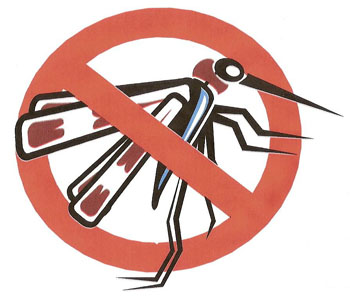
| The Anopheles Mosquito |
The Anopheles mosquito is the only species of insect that is able to carry the malaria causing parasite Plasmodium.
And not only that. Only the female Anopheles mosquito can carry the
parasite. This is because male mosquitoes do not need blood since they
do not lay eggs. The female mosquito will find a blood source (an
unlucky human possibly) and use her proboscis to burrow into the
epidermis to find blood-filled capillaries (Finkel, 2007).
The female's saliva is used to prevent the blood from coagulating so that she can feed. It is through this saliva that Plasmodia, the malaria parasites, are inserted into the blood host.
The Anopheles mosquito has a four stage life cycle: egg, larva, pupa, and adult (CDC, 2010c). The egg, larva, and pupa stages are in the water and typically last from 5-14 days. Mosquito eggs are laid directly on still water, and will hatch within 2-3 days of being laid (in warm climates).
Once the mosquito larvae hatch, they will remain in the water and feed on algae and bacteria. The larvae of Anopheles mosquitoes will survive in fresh or salt-water marshes, mangrove swamps, rice fields, grassy ditches, stream and rivers edges, and even small rain pools. The larvae will metamorphose into pupae after developing through 4 different stages.
Anopheles mosquitoes live all around the world, even in areas where malaria has been eliminated. It is in these areas that malaria could be re-introduced because of immigrants and travelers to malaria-endemic areas of the world.
Plasmodium
Infection with this specific malaria parasite can rapidly progress to a deadly, multi-system disease. There are more than 100 species of Plasmodium that can infect animal species that include reptiles and birds. There are 4 species of Plasmodium that are capable of infecting humans (CDC, 2010c). In humans, complications from this parasite have been documented developing within 48 hours of the first symptoms in a non-immune person, and especially in children under 5, or in pregnant women (Blumberg, 2005). The other Plasmodia, P. vivax, P. ovale, and P. malariae, rarely lead to serious malaria symptoms or complications (Grobusch, 2005). But this is not the case with Plasmodium falciparum.
The National Geographic writer Michael Finkel states
that "fifty thousand of them could swim in a pool the size of the
period at the end of this sentence" (Finkel, 2007). The parasites are
extremely small in size, but only one Plasmodium is need to cause malaria. In order to grow in a blood host, the Plasmodium must first successfully develop in the mosquito from the gametocyte stage to the sporozoite stage. This development depends on temperature and humidity since lower temperatures can affect the development of the parasite (CDC, 2010c). For Plasmodium falciparum, which causes severe malaria, temperatures below 68 degrees Fahrenheit are not conducive to its growth cycle, and thus cannot be transmitted (CDC, 2010c).
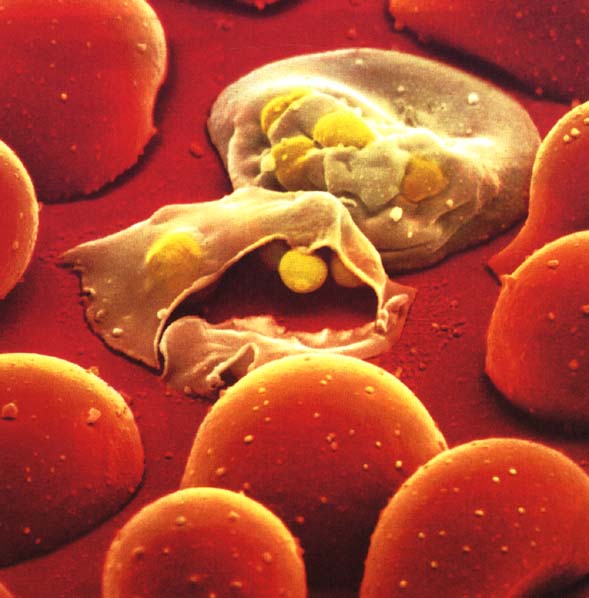
Plasmodium bursting from a red blood cell
Plasmodium species that infect humans:
- P. falciparum:
- found worldwide in tropical and subtropical areas
- an estimated 1 million people are killed by P. falciparum every year
- predominant species in Africa
- can cause severe malaria because of rapid multiplication in the blood which can cause anemia
- can also cause cerebral malaria
- P. vivax:
- found mostly in Asia, Latin America, and in some parts of Africa
- has dormant liver stages that can cause a malarial relapse several months to years after a mosquito bite
- P. ovale:
- found mostly in Africa (especially West Africa) and the islands of the western Pacific.
- P. malariae
- found worldwide
- if left untreated, causes a chronic infection that can possibly last a lifetime.
- can also lead to complications such as nephrotic syndrome
The majority of malaria cases in Africa are caused by Plasmodium falciparum, which is also the species associated with the higher mortality rates (Blumberg, 2005).
Click HERE for a video about malaria from National Geographic.